

Logging into OKX: practical security trade-offs, myths, and what traders in the US should know
Imagine you’re at your desk, market open, a green candle forming on BTC and an alert on your phone—only you can’t sign in to your exchange. That moment separates a routine day from a costly miss or, worse, a security incident if the login failure is the result of a compromise. For US-based crypto traders, knowing how OKX sign in works, what protections are active behind the scenes, and which assumptions are dangerous can be the difference between safe, fast execution and preventable loss.
This piece breaks the process down mechanistically: how authentication and account protection are built, where the real attack surfaces lie, and which trade-offs you accept when choosing convenience features like biometric login or cross-device sessions. I correct three common myths about logging into exchanges and then give a practical checklist and decision framework that you can reuse whenever you set up a new device, approve a withdrawal, or consider linking a Web3 wallet.
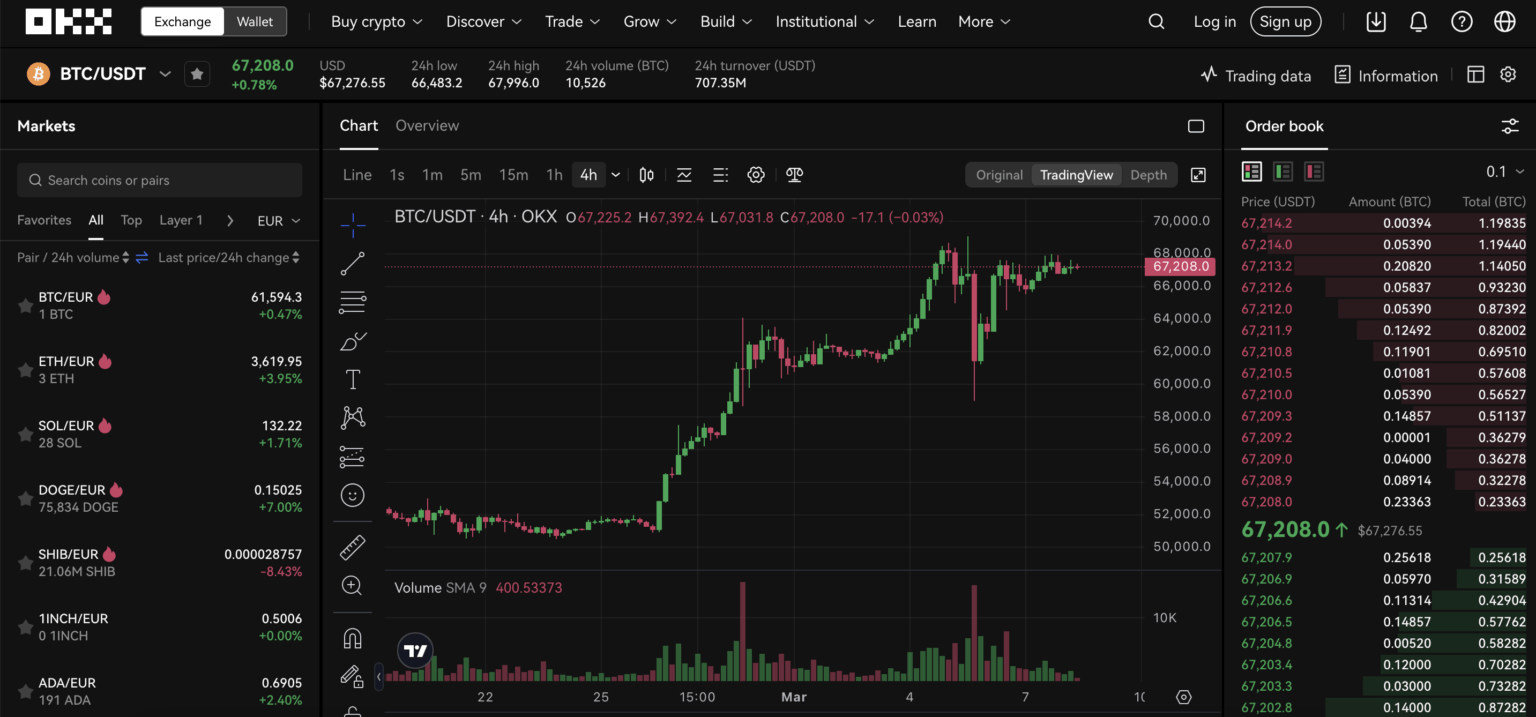
How OKX sign in works in practice: the mechanism under the hood
At a mechanistic level, OKX uses layered authentication: username/password plus a mandatory Two-Factor Authentication (2FA) channel (SMS, Google Authenticator, or biometrics). The exchange also applies military-grade encryption on credentials and deploys AI-driven monitoring to flag anomalous login attempts in real time. For many users this is visible in two ways: when the system requests a second factor during login, and when you receive unusual-login notifications prompting account checks.
Two additional components matter for traders who need both speed and security. First, identity verification (KYC) is required at account creation and for higher withdrawal or product limits; that ties your account to a government ID and a facial liveness check. Second, for custody choices OKX offers both a centralized deposit model (CEX custody, with >95% assets in air-gapped cold wallets and multi-signature withdrawal approvals) and a non-custodial Web3 wallet, where you hold private keys yourself. Each choice changes your threat model.
Three myths about logging into OKX — and the reality
Myth 1: “If my account has KYC, it’s impossible to be hacked.” Reality: KYC links identity to an account, which helps with regulatory compliance and some social-engineering resistance, but it doesn’t eliminate credential theft, SIM swapping, or phishing. AI threat detection reduces risk, but attackers that obtain your 2FA device or seed phrase can still gain access.
Myth 2: “Biometric login always increases security.” Reality: biometrics are convenient and reduce shoulder-surfing or password reuse risks on devices. But biometric templates can be spoofed or extracted, and on some devices they can be bypassed if the operating system is compromised. For high-value accounts, biometrics are best paired with hardware-backed 2FA and strict device hygiene rather than relied on alone.
Myth 3: “Proof of Reserves means my funds are risk-free on the exchange.” Reality: OKX publishes Proof of Reserves for on-chain transparency, which is a strong signal of solvency, but PoR doesn’t eliminate operational, custody, or regulatory risk—nor does it cover off-platform liabilities. For traders in the US, PoR should be one factor in custody decisions, not the totality.
Where login fails, and where it matters most
There are three common failure modes that users encounter and should anticipate: credential compromise (phishing, reused passwords), 2FA loss or SIM swap, and application-level exploitation (malicious browser extensions or compromised mobile OS). Each failure mode requires different mitigation:
– Credential compromise: use a password manager with long unique passwords and enable an authenticator app rather than SMS where possible. Password managers reduce the attack surface from duplicated passwords across sites.
– 2FA loss/SIM swap: prefer hardware-backed 2FA (security keys) or authenticator apps and link account recovery to secure, offline methods. Keep a recovery plan and don’t store seed phrases or backup codes in plain email or cloud notes.
– Application exploitation: keep browsers, OS, and hardware wallets up to date; avoid unverified browser extensions; and use isolated browsers for exchange access when practical.
OKX wallet vs. centralized custody: a contrast with practical consequences
OKX provides a self-custodial Web3 wallet that supports hardware devices like Ledger and Trezor and connects to thousands of DApps, plus a centralized wallet model where the exchange holds keys with most assets in cold storage. Mechanistically, self-custody means you control private keys (single point of critical failure if you lose the seed), while CEX custody centralizes risk but benefits from institutional controls like multi-signature withdrawal approval and cold wallets.
Trade-offs: self-custody reduces counterparty risk (the exchange can’t freeze assets) but increases operational risk (lost seed = permanent loss). Centralized custody reduces the chance of accidental loss and often provides faster trading and staking integration, but it creates exposure to platform operational failures, regulatory action, or insider issues. For active traders in the US who need speed and access to margin or derivatives, a hybrid approach often makes sense: keep trading funds on the exchange and store long-term holdings in a self-custodial wallet with hardware backup.
A practical step: never use the same seed phrase or password across platforms. Use hardware wallets for long-term positions and small, active balances for daily trading on the exchange. If you use the OKX non-custodial wallet for DeFi, review smart contract permissions regularly and revoke unused allowances.
Trading features and login-related operational advice for traders
OKX supports spot and margin trading, futures, options, and derivatives up to high leverage levels (some contracts up to 125x, though margin modes for spot are up to 10x). High-leverage products amplify both gains and losses and increase the urgency of uninterrupted access. For this reason:
– Maintain at least two vetted login paths: primary (your phone and authenticator) and a backup device with the same authenticator app and recovery codes stored offline.
– Use separate accounts or sub-accounts when you run automated strategies versus manual trades; this limits blast radius if credentials or API keys are compromised.
– If you rely on APIs or bots, enforce IP whitelisting and strict key permissions (read-only when possible, withdrawal-disabled for trading bots).
Note: OKX recently delisted several low-liquidity spot pairs—this is a routine risk management action by exchanges to maintain market quality. For traders, that underscores the importance of liquidity checks prior to entering positions on low-volume tokens; a delisting can force conversion steps, potentially creating timing or execution risk.
Decision framework: when to centralize vs. self-custody, and how to sign in safely
Use this three-question heuristic before moving assets or changing login settings:
1) What is the function of the funds? (Trading capital, staking yield, long-term HODL). Match custody to function: trading capital on exchange, long-term in hardware wallet.
2) What is the maximum acceptable outage or loss? If losing access for an hour is costly (open derivatives positions), increase redundancy and use hardware 2FA and an isolated login environment.
3) What is the cost of prevention vs. mitigation? Hardware keys and dedicated devices add friction and cost but materially reduce the probability of account takeover. For most active US traders, the marginal cost is justifiable relative to funds at risk.
Finally, if you need to (re)sign into the platform from a new device, follow a checklist: verify URL (or use a bookmarked, verified path), scan for HTTPS and valid certificate, use an authenticator app or security key, and confirm withdrawal-whitelist settings before moving funds. For one convenient reference to OKX web sign-in pathways and tips, see this page on OKX sign in: okx login.
Limitations, unresolved issues, and what to watch next
Several boundaries deserve attention. Platform-level AI threat detection reduces but does not eliminate sophisticated state-level or targeted social-engineering attacks. Proof of Reserves improves transparency but doesn’t substitute for independent audits of operational security or regulatory compliance. And while exchanges delist weak trading pairs to protect liquidity, this can strand retail positions in thin tokens—meaning traders should avoid allocating large percentages of capital to low-cap assets if they cannot tolerate forced exits.
Signals to monitor in the near term: any changes to 2FA policy (e.g., moves away from SMS), expansions of PoR disclosures, and new integrations with custody insurers or independent audit firms. For US traders, regulatory developments that affect KYC, asset listings, or cross-border custody could change operational practices and access. Treat these as conditional scenarios: if regulators impose new custody requirements, exchanges will adjust limits and verification paths, changing the friction of sign-in and withdrawal.
FAQ — common login, security, and trading questions
Q: I lost my phone and can’t access Google Authenticator—how do I regain OKX access?
A: Follow OKX’s account recovery procedure, which typically requires identity verification using your registered KYC documents and any recovery codes you saved during setup. If you used a hardware security key, use the backup. This is why storing recovery codes offline (paper or hardware-encrypted storage) is crucial. Recovery can take time; plan contingency for open positions.
Q: Is using biometrics on my phone enough to protect my exchange login?
A: Biometrics add convenience and reduce the risk of password reuse but are not a standalone defense for high-value accounts. Combine biometrics with an authenticator app, a hardware security key for critical accounts, and strict device hygiene (OS updates, verified app installs) to materially reduce risk.
Q: Should I move all my assets off OKX because exchanges get hacked sometimes?
A: It’s a risk-management choice. Exchanges like OKX keep the majority of assets in cold storage and use multi-signature withdrawals and PoR to lower custodial risk. A balanced approach is to keep only what you need for active trading on the exchange and store longer-term holdings in a self-custodial hardware wallet.
Q: What’s the safest way to use APIs for automated trading?
A: Create API keys with the minimum required permissions, enable IP whitelisting, avoid withdrawal permissions for bots, rotate keys regularly, and scan logs for unexpected activity. If an API key is compromised, revoke it immediately and review account logs and withdrawal whitelist entries.
Takeaway: signing in is more than entering credentials. It is a point of control where operational discipline, custody choices, and platform protections converge. For US traders who need both speed and safety, the practical sweet spot is redundancy: hardware-backed 2FA, separated custody for long-term funds, and routine hygiene checks for devices, permissions, and token liquidity. That framework turns a fragile moment—the login—into a managed operational step rather than a single point of catastrophic failure.